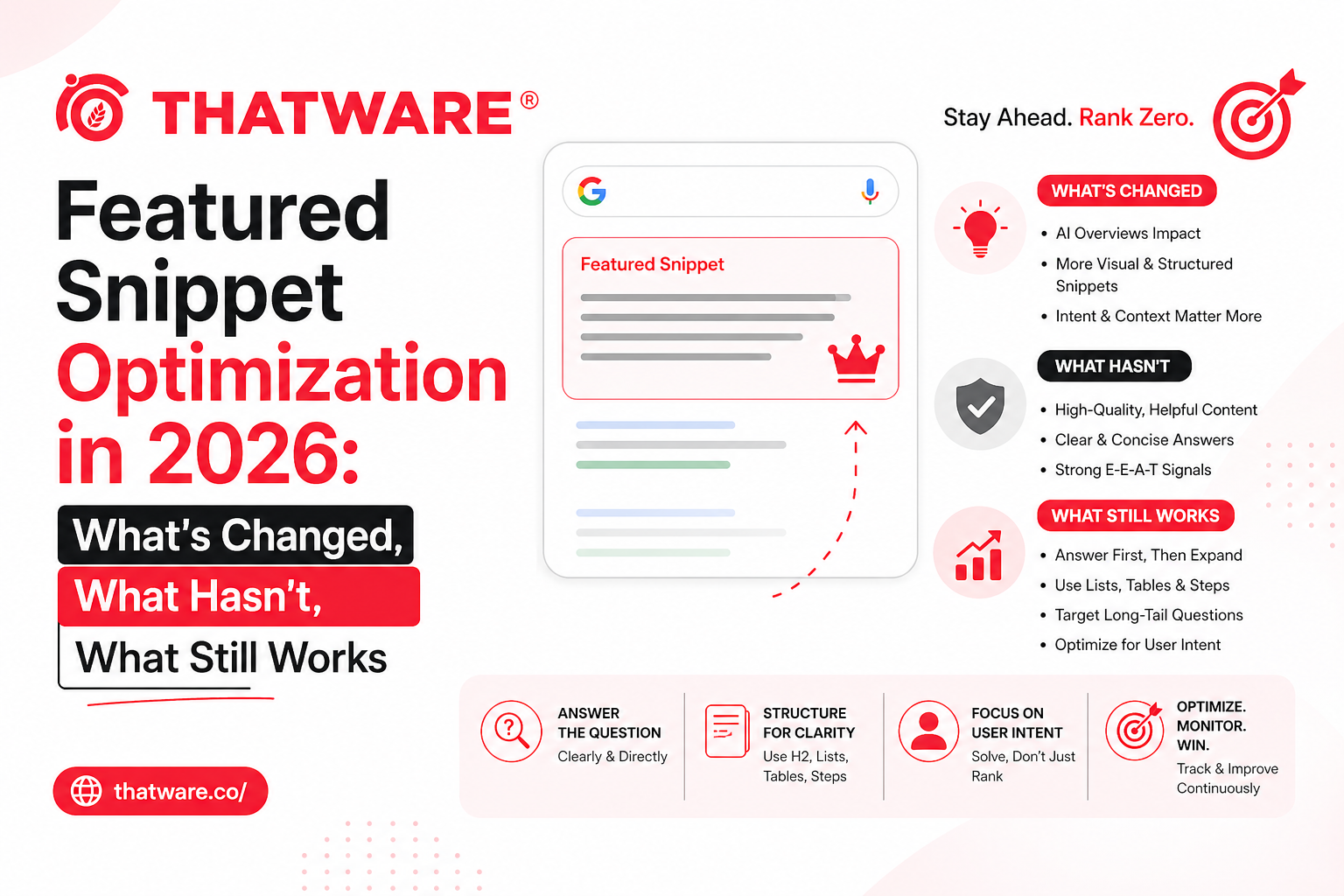
Featured snippets have been a priority for SEO practitioners for almost a decade, and like most things in search, they’ve evolved in ways that make 2018-era advice partially obsolete. The fundamentals of why snippets matter haven’t changed. But the how of winning them has gotten both more competitive and more nuanced.
Here’s an honest state-of-play for 2026, based on what’s actually working now rather than what worked when the tactics were first written up.
What Hasn’t Changed
The core value proposition of featured snippets remains intact. Appearing in position zero, above traditional organic results, with your content displayed directly on the search results page, is genuinely valuable for brand visibility and click-through rates on the queries where it works. For question-based queries, comparison searches, how-to content, and definition requests, the featured snippet position still drives meaningful traffic.
The selection mechanism hasn’t fundamentally changed either. Google is still selecting the content it believes best answers the query based on the explicit question being asked. Clarity, directness, and appropriate format for the query type remain the primary selection criteria.
What has changed is the context around snippets. AI Overviews now appear for many queries that previously showed featured snippets. Voice search has been maturing and the spoken-answer format has become a more significant consideration. The overall search results page looks substantially different from five years ago, which affects how snippet traffic distributes.
What’s Different Now
The relationship between featured snippets and AI Overviews is the most significant new dimension. For many informational queries, Google now shows an AI Overview rather than a traditional featured snippet, or shows both. The AI Overview often draws on the same high-quality sources that would have earned a featured snippet, but the display format is different and the click-through behavior is different.
Featured snippet optimization services that haven’t updated their methodology to account for this new landscape are potentially optimizing for the wrong target. The content characteristics that earn featured snippets and the content characteristics that get cited in AI Overviews are similar but not identical, and the distinction matters for strategy.
Competition for featured snippets has intensified in most commercial categories. The easy wins that existed in 2019 when many question-based queries had no snippet, and any well-structured answer could capture it, have largely been captured. The remaining opportunities tend to require genuinely better content than what currently holds the position, not just better formatting.
What Still Works
Direct question-answer structure remains highly effective. Leading your content with a clear, specific answer to the exact question being asked, before context and qualification, remains one of the most reliable ways to compete for snippet positions. The first paragraph should answer the question. The rest of the content can provide depth, context, and supporting detail.
List and table formats perform well for appropriate query types. How-to content structured as numbered steps, comparison content organized in tables, definition content that follows a consistent structured format. These formats remain favored for their respective query types.
Schema markup continues to matter. FAQ schema in particular can trigger rich result formats that function similarly to featured snippets and are worth implementing for pages covering multiple related questions. HowTo schema for instructional content. These aren’t guaranteed pathways to featured positions, but they’re meaningful signals.
Topic authority underneath the snippet is increasingly important. In competitive categories, Google tends to give featured positions to sources with established topical authority, not just to the page with the best-formatted answer. Building authority in your content area is increasingly a prerequisite for snippet competition, not just a nice-to-have.
Aeo services that understand this environment are building ask-engine optimization strategies that account for both featured snippets and AI Overviews simultaneously, because content that earns one tends to be well-positioned for the other.
The Voice Search Consideration
Voice search has been maturing quietly, and its implications for snippet optimization are worth including in any updated methodology. Voice assistants typically read a single answer aloud, and that answer is often drawn from the featured snippet or AI Overview for the query.
Content optimized for voice answers tends to be slightly shorter and more conversational than content optimized for visual snippet display. Answers that work as spoken responses, typically under thirty words for the core answer, with a clear, complete sentence structure, perform well in voice contexts.
For businesses in categories with significant voice query volume, which tends to be local services, recipes, quick factual queries, and how-to for simple tasks, voice optimization within the broader AEO framework is worth specific attention.
Measuring Snippet Performance
One challenge in snippet optimization is that featured snippets often change the traffic dynamic in ways that standard rank tracking doesn’t fully capture. A page can hold a featured snippet position and receive less click traffic than it did at position one without the snippet, depending on query type and how completely the snippet satisfies the user’s information need.
Tracking snippet hold rate alongside actual click-through performance for snippet-holding pages gives a more accurate picture than rank tracking alone. Google Search Console data on impressions and clicks for snippet-holding pages reveals whether the snippet is driving or suppressing traffic, which should inform how aggressively to pursue snippets for different query types.
The strategy should be optimizing for queries where winning the snippet is genuinely traffic-positive, not just winning snippets for the sake of claiming position zero.